
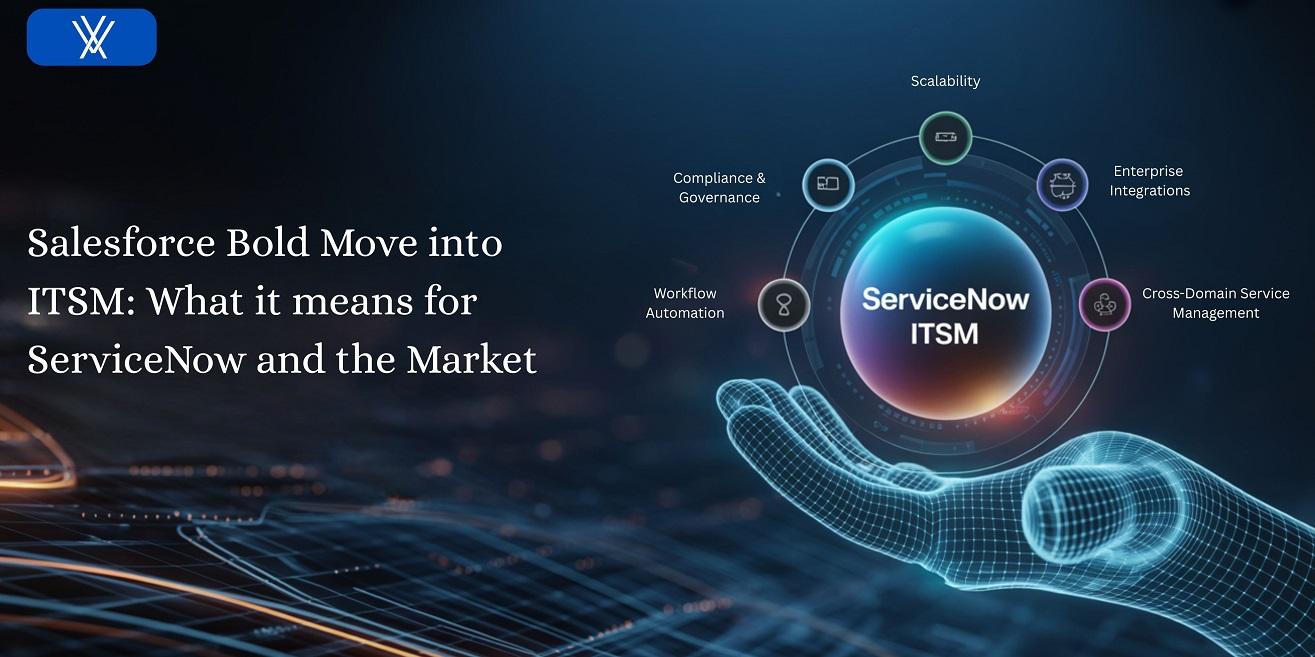
Salesforce has long been recognized as the global leader in customer relationship management (CRM), but its recent push into IT Service Management (ITSM) marks a significant strategic shift. By extending its capabilities beyond sales and customer service into enterprise IT operations, Salesforce is positioning itself as a broader digital platform for service delivery. This move not only reshapes Salesforce’s own product portfolio but also has major implications for ServiceNow—the established market leader in ITSM—and for enterprises evaluating the future of their service management strategies.
Why Salesforce Is Entering the ITSM Space
The demand for modern ITSM is evolving rapidly. Organizations are no longer satisfied with traditional ticketing systems; they want intelligent, automated, and user-friendly service experiences. Salesforce sees an opportunity to meet this demand by leveraging its Service Cloud, AI capabilities, and strong ecosystem. With IT increasingly impacting customer experience, Salesforce’s logic is clear: unify customer service and IT service on a single platform to deliver seamless, end-to-end experiences.
By entering ITSM, Salesforce aims to reduce tool sprawl for enterprises already invested in its ecosystem. Many organizations using Salesforce for CRM and customer service can now extend the same platform, data model, and workflows to internal IT support. This creates a compelling value proposition centered on simplicity, integration, and faster time to value.
Salesforce’s ITSM Approach: AI and Automation at the Core
Salesforce’s ITSM strategy is heavily driven by AI and automation. With Einstein AI, the platform can offer intelligent case routing, predictive insights, automated resolutions, and conversational support. This aligns with broader market trends where AI-driven IT operations are becoming essential for handling growing ticket volumes and complex infrastructure.
Another key strength is Salesforce’s low-code and no-code development capabilities. IT teams can build workflows, automate approvals, and customize service processes with minimal development effort. Combined with real-time analytics and a unified data layer, Salesforce is positioning its ITSM offering as flexible, scalable, and business-friendly.
What This Means for ServiceNow
ServiceNow has dominated the ITSM market for years, building deep capabilities across IT operations, HR, security, and enterprise workflows. Salesforce’s entry does not immediately threaten ServiceNow’s leadership, but it does intensify competition—especially in organizations that already rely heavily on Salesforce.
ServiceNow’s advantage lies in its purpose-built ITSM and IT Operations Management (ITOM) capabilities, along with its strong focus on agentic AI, automation, and enterprise-grade workflows. However, Salesforce’s CRM-first heritage gives it a unique edge in integrating IT services with customer-facing processes. This overlap will likely push ServiceNow to continue accelerating innovation, particularly in user experience, AI-driven resolution, and cross-departmental workflows.
Impact on the Enterprise ITSM Market
For the broader market, Salesforce’s move into ITSM is largely positive. Increased competition drives faster innovation, better pricing models, and more advanced AI features. Enterprises will benefit from more choice, especially when deciding between a best-of-breed ITSM platform and a unified enterprise service solution.
This competition also signals a shift in how ITSM is perceived. IT service management is no longer just about internal IT efficiency; it is about delivering consistent service experiences across employees, customers, and partners. Platforms that can unify these experiences will have a significant advantage in the years ahead.
Choosing the Right Platform: Salesforce or ServiceNow?
The decision between Salesforce and ServiceNow will depend on organizational priorities. Enterprises with complex IT environments, deep IT automation needs, and a strong focus on enterprise workflows may continue to favor ServiceNow. On the other hand, organizations already invested in Salesforce may find value in extending ITSM on the same platform to reduce integration complexity and improve data consistency.
Ultimately, both platforms are investing heavily in AI, automation, and intelligent workflows. This means enterprises can expect smarter IT operations, faster issue resolution, and improved user satisfaction regardless of the platform they choose.
Conclusion
Salesforce’s bold move into ITSM marks a new phase in the evolution of enterprise service management. By leveraging AI, automation, and its Service Cloud ecosystem, Salesforce is challenging traditional ITSM boundaries and intensifying competition with ServiceNow. For the market, this translates into accelerated innovation, more AI-driven IT operations, and better service experiences. As Salesforce and ServiceNow continue to push each other forward, enterprises stand to gain the most from this rapidly evolving ITSM landscape.

 English
 Arabic
 French
 Spanish
 Portuguese
 Deutsch
 Turkish
 Dutch
Dutch
 Russian
 Romaian
 Portuguese (Brazil)
 Greek
Greek