
The freedom of the open road is a feeling like no other. But for motorcyclists, that freedom comes with inherent vulnerability. Sharing the road with larger vehicles and navigating unpredictable hazards means that having an unbiased witness isn’t just a luxury—it’s a layer of essential protection. Enter the motorcycle dash cam, a rider’s digital guardian angel.
This ultimate guide will walk you through everything you need to know: from the critical legal considerations before you hit record, to the practical steps of installation, and finally, to our top picks for cameras that deliver peace of mind. Whether you’re a daily commuter or a weekend adventurer, this guide will help you choose and use the right motorcycle dash cam for your journey.
Part 1: Understanding the Law – Are Motorcycle Dash Cams Legal?
Before you mount a camera, it’s crucial to understand the legal landscape. The short answer is: in most places, yes, motorcycle dash cams are legal. However, the devil is in the details, and laws vary significantly by country and even by state or province.
Key Legal Considerations:
-
Audio Recording and Two-Party Consent: Video recording in public is generally legal, as there is no expectation of privacy. However, recording audio is a different matter. Some regions require “two-party consent,” meaning you must inform and get permission from anyone you record a conversation with. If your camera records audio, it’s your responsibility to know the local laws. Often, the simplest solution is to disable the audio recording function in the camera’s settings.
-
Data Protection and Privacy (Especially in Europe): Countries governed by the GDPR (General Data Protection Regulation) in Europe have strict rules about capturing footage of individuals. While personal use is often exempt, publicly uploading footage that clearly identifies people (especially license plates) can be a gray area. The general principle is to use the footage for its intended purpose—evidence and personal security—and not for public shaming without caution.
-
Helmet-Mounted Camera Laws: This is a critical area of variation. Some jurisdictions have specific laws about what can be attached to a safety helmet, fearing that mounts could compromise its structural integrity. Always check your local vehicle code to see if helmet cams are explicitly permitted or banned. When in doubt, a handlebar or chassis mount is a safer legal bet.
The Golden Rule: The onus is on you, the rider, to research the specific laws in your area. A quick search for “[Your State/Country] motorcycle dash cam laws” or a call to your local Department of Motor Vehicles can provide clarity and prevent potential legal headaches.
Part 2: Installation Guide – Hardwiring vs. Simple Power
Installing a motorcycle dash cam can range from a simple 5-minute job to a more involved wiring project. The method you choose depends on your technical comfort and how “permanent” you want the setup to be.
Option 1: The Simple Plug-and-Play Method
This is the easiest way to get started, ideal for those who are less technically inclined or who want the flexibility to easily remove the camera.
- How it works: Use the camera’s included USB cable and plug it into a USB port or a 12V accessory socket (cigarette lighter) on your motorcycle. If your bike doesn’t have one, you can install a simple USB charger.
- Pros: Extremely easy, no technical skill required, easy to remove.
- Cons: Can result in visible wires; typically only powers the camera when the bike is running, so no parking mode.
Option 2: The Professional Hardwiring Method
For a clean, permanent installation that can enable features like parking mode, hardwiring is the best choice.
- How it works: The camera is connected directly to the motorcycle’s battery via a hardwiring kit, which often includes fuse taps. The wires are then neatly tucked away under the bike’s fairings or along the frame.
- Pros: Very clean, professional look; enables parking mode (if the camera supports it) to record bumps or vandalism while the bike is parked.
- Cons: Requires more technical skill; you must ensure the kit has a low-voltage cutoff to prevent draining your battery.
Installation Tips for Any Method:
- Secure Your Mount: Ensure the mount is on a solid, non-moving part of the bike. Use threadlocker on screws to prevent vibrations from loosening them over time.
- Route Wires Safely: Keep wires away from hot areas like the engine and moving parts like the steering stem. Use zip ties to secure them neatly.
- Angle the Camera Correctly: Position the lens to capture a clear view of the road ahead, with the horizon roughly in the center of the frame. Test it with a short ride before finalizing the mount.
Part 3: What to Look For in a Top-Tier Motorcycle Dash Cam
Not all cameras are created equal. The harsh environment of a motorcycle demands specific features.
- Video Quality: 1080p at 60fps is the modern baseline for capturing clear, smooth footage where license plates are readable. 4K offers more detail but creates larger files.
- Stabilization (The Most Important Feature): Engine vibration will ruin unstabilized footage. Electronic Image Stabilization (EIS) or gyro-based stabilization is absolutely essential for watchable video.
- Durability and Weatherproofing: Look for a high IP (Ingress Protection) rating. IP67 or IP68 ensures the camera is dust-tight and protected from heavy rain.
- Loop Recording & G-Sensor: Loop recording automatically overwrites old footage, so you never run out of space. A G-sensor locks footage automatically upon impact, saving it from deletion.
- Power Source: Cameras with capacitors are better than those with only lithium-ion batteries, as capacitors handle extreme temperatures (hot or cold) more reliably.
Part 4: A Top Pick for the Versatile Rider
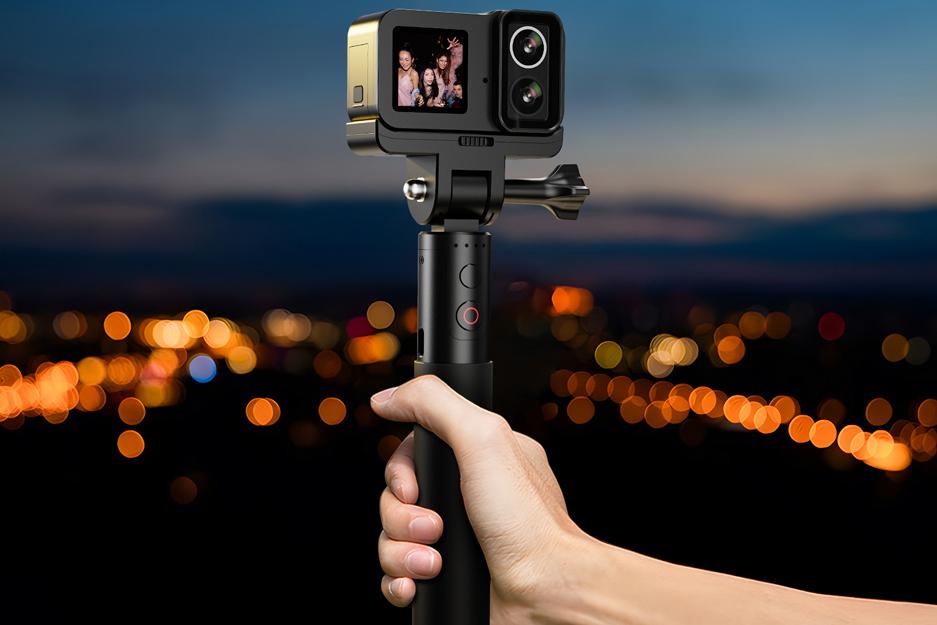
While there are many dedicated motorcycle dash cam systems, some riders want a device that can do it all: serve as a reliable witness and capture high-quality adventure footage. For those seeking a powerful hybrid solution, the SJCAM SJ20 Action Camera is an outstanding choice.
The SJCAM SJ20 is engineered to perform brilliantly on a motorcycle. It shoots stunningly detailed 4K video and super-smooth 1080p at 60fps, ensuring critical evidence is captured with clarity. Its advanced 6-axis gyro stabilization is specifically tuned to counteract the unique vibrations of a motorcycle, delivering footage that is remarkably steady. With a robust IP68 waterproof rating, it’s built to withstand the elements right out of the box.
What makes the SJ20 particularly compelling for dash cam use is its dedicated Car DVR Mode. This feature transforms it from a standard action camera into a functional dash cam, enabling automatic start/stop recording with power and loop recording. This versatility means the SJ20 is just as capable of safeguarding your daily commute as it is documenting your next epic road trip, making it a truly smart investment for the modern rider.
By understanding the laws, mastering the installation, and choosing a camera with the right features, you can add a powerful layer of security to your riding experience. A motorcycle dash cam is more than just a camera; it’s your silent partner on the road, always ready to have your back.

 English
 Arabic
 French
 Spanish
 Portuguese
 Deutsch
 Dutch
Dutch
 Italiano
 Russian
 Romaian
 Portuguese (Brazil)
 Greek
Greek