
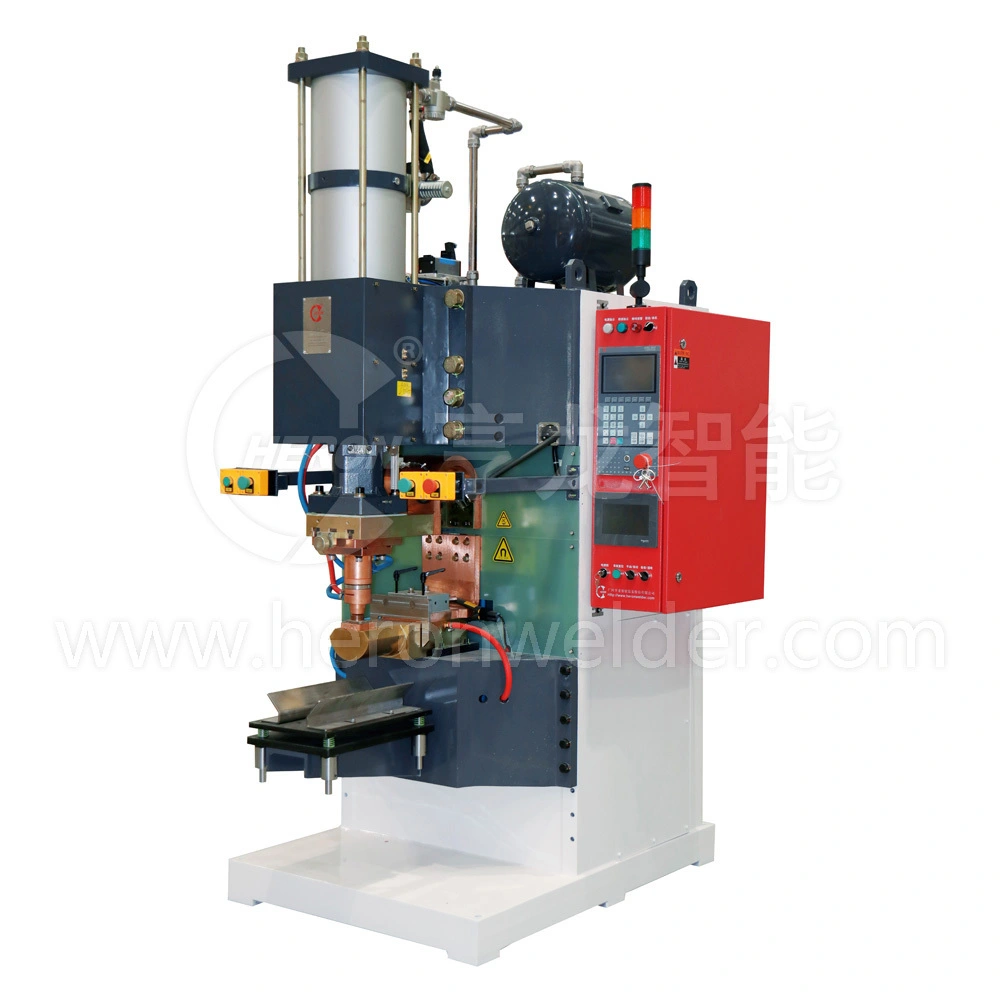
In modern manufacturing, precision, repeatability, and efficiency are critical for high-quality metal joining. One solution that has consistently delivered reliable results across automotive, electronics, and appliance industries is the projection welder. Designed for joining complex components with accuracy and speed, projection welding offers a versatile alternative to traditional spot welding, making it an essential tool for manufacturing engineers, OEMs, and automation integrators.
Heron Welder, a global leader in industrial welding equipment, provides advanced projection welding machines, controllers, and automated production solutions tailored to your factory requirements. In this guide, we explore projection welder principles, applications, advantages, and best practices, helping decision-makers select the right solution for their production lines.
What Is a Projection Welder?
A projection welder is a type of resistance welding machine specifically designed to join metal components with pre-formed projections or embossed features. Unlike conventional spot welding, where electrodes contact the surface directly, projection welding focuses the electrical current onto the raised projections. This concentrates heat at precise locations, allowing strong welds with minimal distortion.
Key components of a projection welding system include:
-
Welding electrodes – Shaped to match the projection and ensure even current flow.
-
Transformer or MFDC power source – Provides controlled current for precise weld penetration.
-
Fixture or clamping system – Holds components securely, ensuring alignment and repeatability.
-
Controller – Monitors current, force, and weld time to maintain consistency.
By concentrating energy on the projection points, projection welders can efficiently join thicker materials or multiple layers with reduced energy consumption and improved cycle times.
How Projection Welding Works
Projection welding relies on the principle of resistance heating. The steps include:
-
Alignment – Metal parts with pre-formed projections are positioned in the welding fixture.
-
Clamping – Electrodes apply mechanical force, pressing the parts together.
-
Current Flow – Electrical current flows through the projections, which have higher resistance than the surrounding metal.
-
Localized Heating – Heat generated at the projections melts the metal at the interface.
-
Solidification – Once the current stops, the weld solidifies under pressure, creating a strong bond.
This process allows for high-precision welding with minimal damage to surrounding areas, making projection welding ideal for thin sheets, complex assemblies, and multi-layer components.
Common Applications of Projection Welders
Projection welding is widely used in industries that demand consistent, high-strength joints. Typical applications include:
Automotive Industry
-
Joining battery tabs, brackets, and electrical connectors.
-
Attaching nuts, studs, and threaded components to panels.
-
Welding multi-layer steel sheets for chassis and body structures.
Electronics and Appliances
-
Fabricating enclosures, connectors, and small electrical assemblies.
-
Joining thin sheet metals without warping delicate components.
Industrial Equipment and HVAC
-
Fastening brackets, clips, and reinforcement plates.
-
Welding high-volume sheet metal assemblies efficiently.
Heron Welder’s projection welding machines are designed for high-speed production, providing consistent quality and integration with automated assembly lines for mass manufacturing.
Advantages of Projection Welding Over Spot Welding
While spot welding remains common in manufacturing, projection welding offers several advantages:
| Feature | Spot Welding | Projection Welding |
|---|---|---|
| Heat Localization | Broad area | Focused at projections |
| Material Thickness | Limited | Handles thicker and multi-layer metals |
| Weld Consistency | Moderate | High repeatability with less distortion |
| Electrode Wear | Frequent | Reduced due to concentrated current |
| Automation | Possible | Ideal for high-volume automated lines |
These benefits make projection welding particularly valuable for factories seeking reduced cycle times, lower energy consumption, and higher joint quality.
Best Practices for Projection Welding
To maximize the performance and lifespan of a projection welder, consider the following best practices:
-
Correct Projection Design – Ensure projections are properly formed to concentrate heat without causing blow-through.
-
Electrode Selection – Use electrodes with suitable shapes, materials, and cooling systems for consistent welds.
-
Controlled Welding Parameters – Optimize current, force, and weld time based on material thickness and type.
-
Regular Maintenance – Clean electrodes, inspect fixtures, and calibrate controllers to maintain repeatability.
-
Integration with Automation – Combine projection welding with robotic or automated handling systems for increased productivity.
Heron Welder provides customized solutions including MFDC and capacitor discharge projection welders, designed for both manual and fully automated production lines.
Why Choose Heron Projection Welders
Heron Welder is a trusted partner for manufacturers worldwide, delivering machines that meet stringent industrial standards:
-
Global Expertise – Over decades of experience supplying advanced welding solutions.
-
Custom Solutions – Machines, controllers, and fixtures tailored to your production needs.
-
Automation Integration – Seamless integration with robotics and assembly lines.
-
Comprehensive Support – Training, technical service, and maintenance programs.
Whether you are an OEM, system integrator, or factory manager, Heron projection welders provide precision, efficiency, and reliability for your metal-joining operations.
FAQs About Projection Welding
1. What metals can be joined with a projection welder?
Projection welders can join steel, stainless steel, aluminum, nickel alloys, and multi-layer assemblies.
2. Can projection welding be automated?
Yes. Projection welding is highly suitable for robotic integration, improving speed, accuracy, and repeatability.
3. How is projection welding different from spot welding?
Projection welding focuses the electrical current on embossed projections, whereas spot welding contacts the surface directly. This allows for stronger welds and less distortion.
4. What industries benefit most from projection welding?
Automotive, electronics, appliances, HVAC, and heavy industrial manufacturing commonly use projection welding for high-volume production.
5. How do I choose the right projection welder for my factory?
Consider material type, sheet thickness, weld size, production volume, and whether automation or robotic integration is required. Heron Welder’s experts can provide customized recommendations.
Request a Quote
Ready to enhance your metal-joining process with precision projection welding? Contact Heron Welder today for a tailored consultation or request a quote. Our experts will help you select the ideal projection welding machine, integrate it into your production line, and optimize your operations for maximum efficiency and quality.

 English
 Arabic
 French
 Spanish
 Portuguese
 Deutsch
 Turkish
 Dutch
Dutch
 Italiano
 Romaian
 Portuguese (Brazil)
 Greek
Greek