
As the demand for reliable power distribution grows globally, selecting the right overhead cable is critical for utilities, EPC contractors, and industrial power projects. HNBF Power, a leading global manufacturer of overhead conductors and power cables, offers advanced solutions designed to meet the needs of modern power infrastructure. In this guide, we explore the types, applications, and technical considerations of overhead cables to help engineers and procurement teams make informed decisions.
What Is an Overhead Cable?
An overhead cable is an electrical conductor that transmits and distributes electricity above the ground, typically supported by poles or transmission towers. Unlike underground cables, overhead cables are exposed to environmental factors such as wind, temperature fluctuations, and pollution, which makes material selection and design critical.
HNBF Power manufactures a wide range of overhead cables, including AAC (All Aluminum Conductor), AAAC (All Aluminum Alloy Conductor), ACSR (Aluminum Conductor Steel Reinforced), and ABC (Aerial Bundled Cable), each engineered to ensure high performance, durability, and safety in diverse power transmission applications.
Types of Overhead Cables
1. AAC (All Aluminum Conductor)
AAC cables are made entirely of aluminum, offering excellent conductivity, lightweight design, and corrosion resistance. They are commonly used in low to medium voltage distribution networks, especially in urban and rural areas where line spans are short and mechanical strength requirements are moderate.
2. AAAC (All Aluminum Alloy Conductor)
AAAC overhead cables combine lightweight aluminum with alloy properties to enhance tensile strength without compromising conductivity. This makes them suitable for longer transmission spans and areas with higher mechanical stress, offering a cost-effective alternative to traditional steel-reinforced conductors.
3. ACSR (Aluminum Conductor Steel Reinforced)
ACSR cables feature a steel core surrounded by aluminum strands, delivering superior mechanical strength for high-voltage, long-distance transmission. HNBF Power’s ACSR conductors are engineered to withstand heavy loads, wind, and ice conditions, making them ideal for challenging terrains and large-scale power networks.
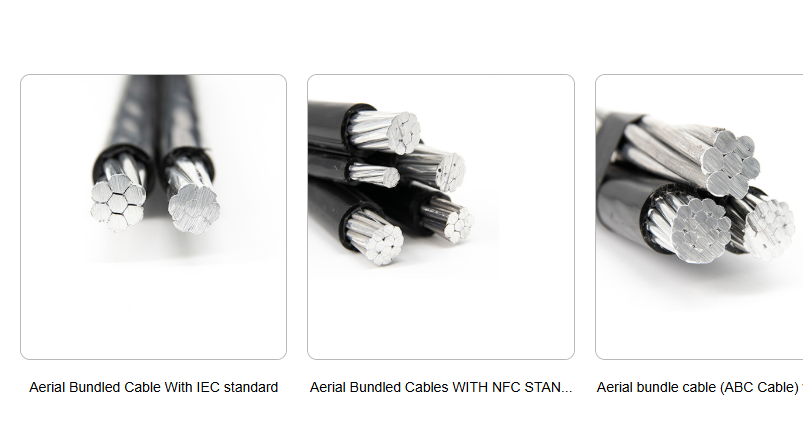
4. ABC (Aerial Bundled Cable)
ABC overhead cables are insulated and bundled, reducing power losses and improving safety. They are widely adopted in urban and semi-urban areas to replace bare conductors, offering reduced risk of electrical faults and easier maintenance.
Key Considerations When Choosing Overhead Cables
When selecting an overhead cable for your project, engineers and procurement teams should consider the following factors:
-
Current-carrying capacity: Ensure the cable can handle peak loads without overheating.
-
Mechanical strength: Evaluate the conductor’s ability to withstand environmental stress such as wind, ice, and sag.
-
Corrosion resistance: Choose materials that resist oxidation and environmental degradation.
-
Installation environment: Urban, rural, or industrial settings may require specific conductor types.
-
Maintenance requirements: Consider ease of inspection, fault detection, and replacement.
HNBF Power provides detailed technical specifications and customized options to match every project requirement, ensuring optimal performance and longevity.
Advantages of HNBF Power Overhead Cables
-
Global Compliance: HNBF Power cables meet international standards for quality and safety.
-
Durability: Engineered to withstand harsh environmental conditions, reducing maintenance costs.
-
Efficiency: Optimized for minimal energy loss and high conductivity.
-
Customization: Solutions tailored to specific project needs, from conductor type to insulation and packaging.
By leveraging advanced manufacturing techniques and stringent quality control, HNBF Power ensures that every overhead cable performs reliably throughout its service life.
Frequently Asked Questions (FAQs)
Q1: What is the difference between AAC and ACSR cables?
AAC cables are purely aluminum, lightweight, and suitable for shorter spans. ACSR cables have a steel core for higher tensile strength, ideal for long-distance transmission.
Q2: Can overhead cables be used in urban areas?
Yes. ABC cables, which are insulated and bundled, are particularly suited for urban and semi-urban installations, offering higher safety and reduced fault risks.
Q3: How do environmental conditions affect overhead cables?
Wind, temperature changes, ice, and pollution can impact sag, tensile strength, and corrosion. Selecting the right conductor material is crucial for reliability.
Q4: What customization options does HNBF Power offer?
HNBF Power provides tailored solutions for conductor type, size, insulation, and packaging to meet specific project requirements and environmental conditions.
Q5: How long do HNBF Power overhead cables typically last?
With proper installation and maintenance, HNBF Power overhead cables can serve efficiently for several decades, ensuring minimal downtime and consistent power delivery.
Conclusion
Choosing the right overhead cable is a vital step in building reliable, efficient, and durable power transmission networks. HNBF Power stands out as a trusted global supplier, offering a comprehensive range of AAC, AAAC, ACSR, and ABC conductors designed to meet the demanding needs of engineers and procurement teams worldwide.
For tailored solutions and technical support for your next power project, contact HNBF Power today and ensure your network achieves unmatched reliability and performance.

 English
 Arabic
 French
 Spanish
 Portuguese
 Deutsch
 Turkish
 Italiano
 Russian
 Romaian
 Portuguese (Brazil)
 Greek
Greek