
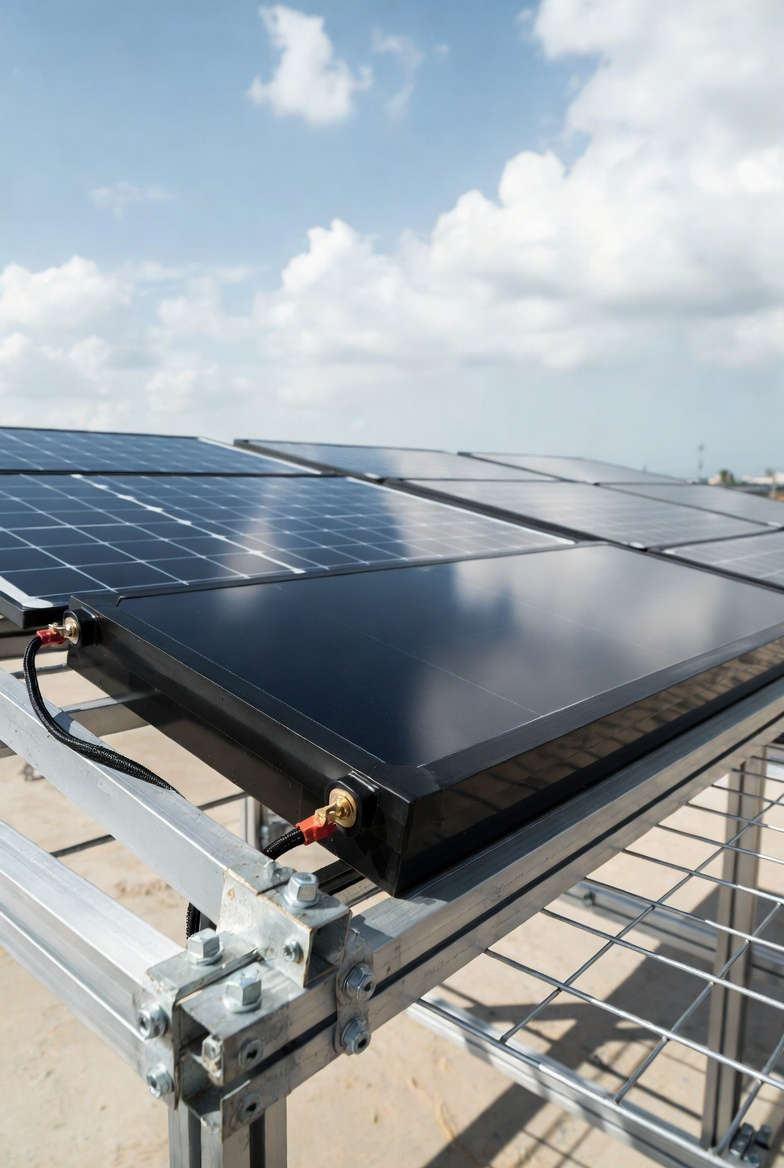
On paper, a 12V 100Ah lithium solar setup looks straightforward. The battery stores energy, the inverter converts it, and the load consumes it. In reality, a large portion of usable capacity disappears silently inside the inverter itself. Most system owners never see these losses, yet they feel them every day through shorter backup time and underperforming systems.
At Hybridev Engineering, we focus on what actually happens between stored energy and delivered power. When users believe their battery is underperforming, the real issue is often inverter inefficiency—not the battery.
What Inverters Really Do to Stored Energy
An inverter does more than convert DC to AC. It regulates voltage, filters waveforms, manages switching frequencies, and protects itself from overload. Each of these actions consumes energy.
In a 12V 100Ah lithium solar system, inverter losses are amplified because low-voltage systems require higher current. Higher current means more heat, more resistance loss, and more wasted energy before power ever reaches your appliances.
Conversion Efficiency Is Not a Fixed Number
Most inverters advertise peak efficiency, not real-world efficiency. That peak rating only occurs at a narrow load range. Outside that range, efficiency drops—sometimes sharply.
This matters because 12V 100Ah lithium solar setups often operate at partial load. During these conditions, inverter efficiency can fall by 10–20%, instantly reducing usable battery capacity without any visible fault.
Idle Consumption: The Capacity Killer No One Measures
Even when no appliances are running, inverters draw power. Cooling circuits, control boards, and monitoring systems stay active 24/7.
In small systems, idle consumption alone can drain a meaningful portion of a 12V 100Ah lithium solar battery overnight. Users often blame the battery, unaware that the inverter has been quietly consuming energy the entire time.
Waveform Quality and Heat Loss
Pure sine wave inverters are essential for sensitive electronics, but producing clean waveforms requires high-frequency switching. This switching creates internal heat, and heat equals energy loss.
Lower-quality inverters convert more energy into heat instead of usable output. Over time, this reduces effective runtime and accelerates system stress, even when paired with a premium battery.
Why Low Voltage Magnifies Inverter Losses
At 12 volts, delivering meaningful AC power requires very high current on the DC side. High current increases resistive losses in internal components, cables, and connectors.
This is why inverter selection is critical in 12V 100Ah lithium solar systems. Poor inverter design wastes energy long before it reaches the load, shrinking real capacity without reducing rated battery specs.
Battery Quality vs. Inverter Reality
Many users invest heavily in premium batteries while pairing them with average inverters. This mismatch undermines the entire system.
In markets where buyers actively compare 12V 100Ah lithium solar battery LiFePO4 Pakistan price, attention often focuses on cell chemistry and cycle life. Yet inverter losses can erase the advantages of even the best battery if system efficiency is ignored.
Load Profile Mismatch and Hidden Waste
Inverters are most efficient near their optimal load range. Oversized inverters running small loads operate inefficiently, wasting energy every hour.
This mistake is common in 12V 100Ah lithium solar setups built for “future expansion.” Until that expansion happens, the system silently bleeds capacity through inefficient conversion.
Thermal Stress Reduces Usable Energy Further
Heat generated by inverter inefficiency raises internal temperatures. Higher temperatures force protective derating, reducing output power and shortening runtime.
In hot regions, this compounds the problem. When evaluating 12V 100Ah lithium solar battery LiFePO4 Pakistan price, thermal compatibility between battery and inverter becomes a decisive factor in real performance.
Why Price Comparisons Miss the Real Cost
Two systems with identical batteries can deliver very different runtime results. The difference is almost always the inverter.
A slightly higher upfront investment in a high-efficiency inverter often delivers more usable energy than upgrading battery capacity. This is why smart system design outperforms simple component shopping.
At Hybridev Engineering, we see this mistake repeatedly: users chase battery upgrades while inverter losses remain unaddressed.
Making Inverter Losses Work for You, Not Against You
Proper inverter sizing, high-efficiency topology, low idle draw, and thermal optimization transform system performance. These choices protect your investment and unlock the full potential of your battery.
For buyers analyzing 12V 100Ah lithium solar battery LiFePO4 Pakistan price, understanding inverter behavior is the difference between theoretical capacity and real-world reliability.
Final Takeaway: Capacity Is a System Outcome
Usable capacity is not defined by the battery alone. It is the result of how efficiently energy flows through the entire system.
A well-designed 12V 100Ah lithium solar setup delivers predictable runtime, stable output, and long-term value. Ignore inverter losses, and no battery—no matter how advanced—can compensate.
If you want systems that perform as expected, invest in engineering, not assumptions. That decision pays back every single day.

 English
 French
 Spanish
 Portuguese
 Deutsch
 Turkish
 Dutch
Dutch
 Italiano
 Russian
 Romaian
 Portuguese (Brazil)
 Greek
Greek