
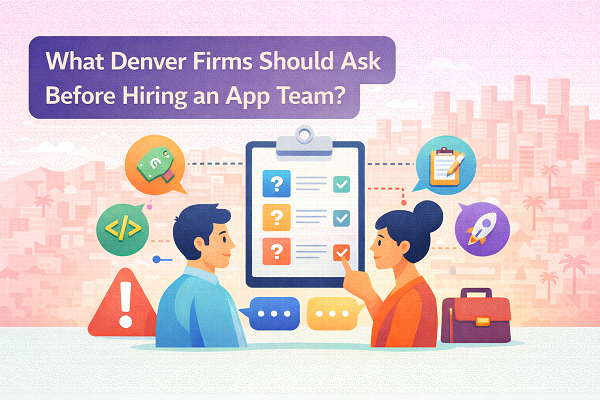
The most expensive mistakes in app development rarely come from bad code. They come from unanswered questions. Questions that felt uncomfortable to ask. Questions that seemed premature. Questions that were skipped because timelines felt tight or confidence felt high.
Denver firms have learned this the hard way. As apps become central to revenue, operations, and customer trust, hiring an app team is no longer a creative experiment. It is a business decision with long-term consequences. Asking the right questions before signing a contract often matters more than negotiating price or reviewing a portfolio.
This guide focuses on the questions Denver firms should ask early, before enthusiasm overrides clarity.
Start by asking how the team understands your problem
Before asking how something will be built, ask how the team understands what you are trying to solve.
A strong team should be able to clearly explain your business problem, users, and constraints in their own words. If they immediately jump into technology choices or feature lists, alignment may already be missing.
This question reveals whether the team listens first or assumes first. In Denver’s mature app market, listening is a competitive advantage.
Ask what success looks like after launch
Many teams define success as shipping on time. Denver firms increasingly define success as stability, adoption, and the ability to change without disruption.
Ask how success is measured three months after launch. Six months after. One year later. The answers will show whether the team thinks in milestones or in outcomes.
Teams that only talk about launch are usually not thinking far enough ahead.
Ask who owns decisions when priorities change
Change is inevitable. Markets shift. Users behave differently than expected. Internal stakeholders revise goals.
Ask how the team handles change. Who makes prioritization decisions. How trade-offs are evaluated. How scope changes affect timeline and cost.
Clear change management processes reduce conflict and protect budgets. Vague answers often lead to tension later.
Ask how estimates are created and what assumptions they rely on
Estimates are not promises. They are models based on assumptions.
Ask what assumptions underpin the estimate. Ask what would cause the estimate to change. Ask how often estimates are revisited.
Denver firms that understand this early experience fewer surprises and more collaborative decision-making during development.
Ask what happens after the app goes live
Launch is when exposure begins.
Ask about monitoring, incident response, update processes, and support expectations. Ask how issues are detected and escalated. Ask who is responsible when something breaks.
Teams that treat post-launch support as an afterthought often struggle with production realities. Teams that discuss it naturally tend to operate more calmly under pressure.
Ask how security and data protection are handled
Even basic apps handle sensitive data.
Ask how data is stored, who can access it, how permissions are managed, and how security updates are handled over time. Ask how compliance requirements are addressed if your industry is regulated.
Clear, plain-language answers signal maturity. Overly technical or evasive responses should raise concerns.
Ask what documentation you will receive
Documentation protects continuity.
Ask what documentation is included at delivery. Architecture overviews. Setup instructions. Deployment processes. Onboarding guides.
Denver firms that insist on documentation reduce dependency on any single individual or vendor and lower long-term risk.
Ask how the team has handled failure in the past
Every experienced team has faced failure.
Ask about a project that did not go as planned. What happened. What was learned. What changed afterward.
Teams that can discuss failure openly tend to manage risk better than those who present only success stories.
Ask how communication will actually work
Ask how often updates are provided. In what format. Who communicates with whom. How decisions are documented.
Denver firms increasingly prefer predictable, transparent communication over constant availability. Structure matters more than speed.
Ask how the team balances speed with quality
Every app involves trade-offs.
Ask how the team decides when to move fast and when to slow down. Ask what quality safeguards are in place. Ask what corners they refuse to cut.
The answers reveal values, not just process.
Ask what happens if you decide to change partners later
This is an uncomfortable but necessary question.
Ask how easy it would be for another team to take over the project. Ask about code ownership, access, documentation, and handover support.
Teams confident in their work are not threatened by this question. Teams that resist it often create hidden lock-in.
Ask how cost transparency is maintained over time
Ask how budgets are tracked. How overruns are flagged. How cost changes are communicated.
Denver firms have learned that surprises are more damaging than higher costs. Transparency builds trust even when budgets shift.
Ask what makes them say no to a client
This question is revealing.
Teams that can explain when they push back show judgment and experience. Teams that say yes to everything often struggle to protect the product and the client.
Healthy pushback is a sign of partnership, not resistance.
Why these questions matter in Denver today
Denver’s app ecosystem has moved beyond experimentation. Many firms now operate apps that customers, employees, and partners rely on daily.
When businesses search for mobile app development Denver options today, they are often looking for reliability, ownership, and long-term thinking, not just technical execution.
The questions you ask before hiring shape the answers you get after launch.
Closing thought
Choosing an app team is not about finding the most confident pitch. It is about finding a team that can live with the consequences of its decisions.
The right questions create alignment. Alignment reduces risk. And reduced risk is often the biggest return on investment a Denver firm can make before a single line of code is written.

 English
 Arabic
 French
 Spanish
 Portuguese
 Deutsch
 Turkish
 Dutch
Dutch
 Russian
 Romaian
 Portuguese (Brazil)
 Greek
Greek