
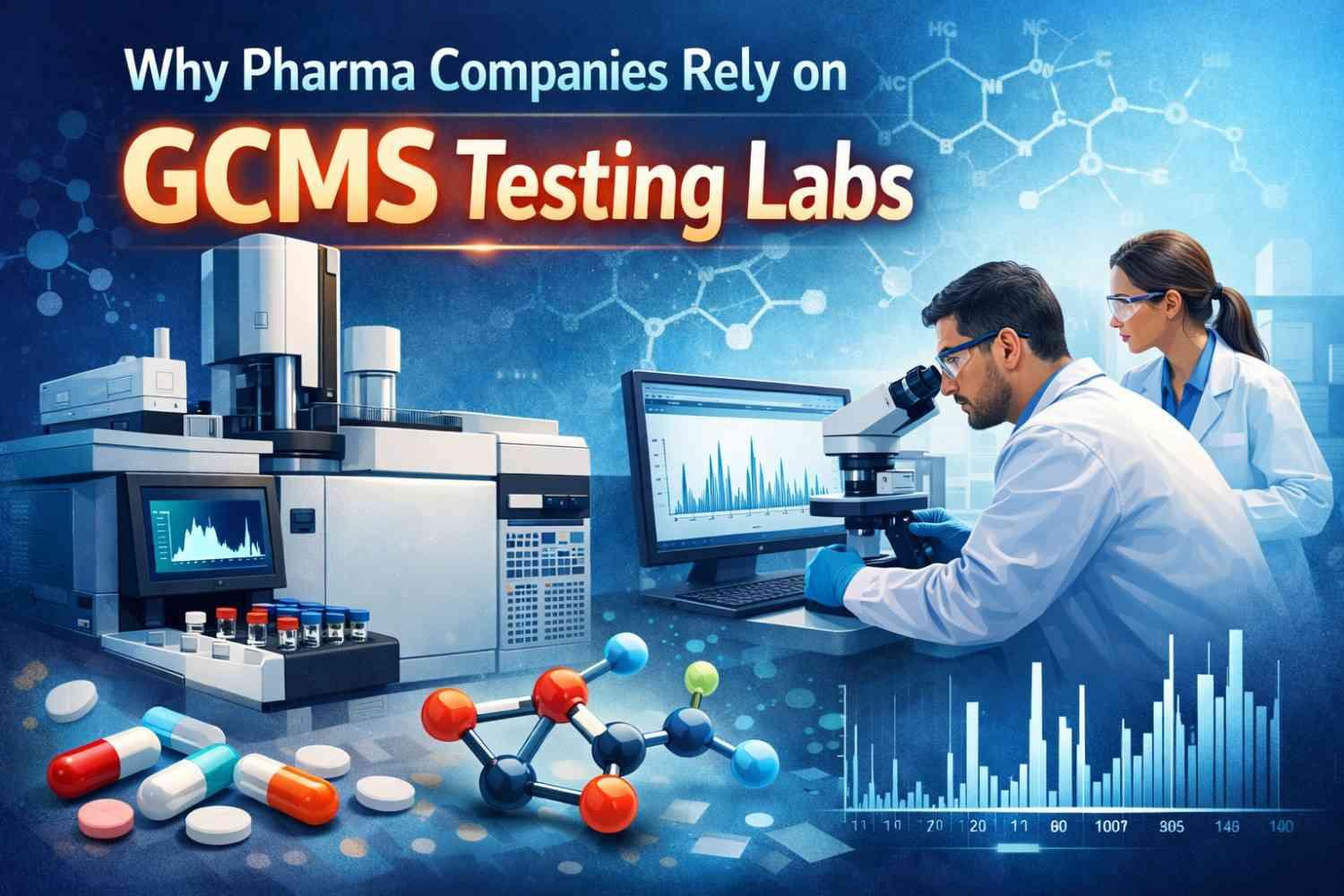
In today’s highly regulated pharmaceutical landscape, precision, compliance, and patient safety are non-negotiable. From early drug discovery to final product release, analytical testing plays a critical role in ensuring medicines are safe, effective, and consistent. Among the many analytical techniques available, Gas Chromatography–Mass Spectrometry (GCMS) has become a cornerstone—making GCMS testing labs indispensable partners for pharmaceutical companies worldwide.
1. Unmatched Accuracy in Chemical Identification
GCMS combines two powerful techniques: gas chromatography for separating complex mixtures and mass spectrometry for identifying compounds at the molecular level. This dual capability allows pharmaceutical companies to:
- Precisely identify unknown compounds
- Detect trace-level impurities
- Confirm molecular structures with high confidence
Such accuracy is vital when even minute contaminants can affect drug safety or efficacy.
2. Critical for Impurity & Residual Solvent Analysis
Regulatory agencies strictly limit impurities and residual solvents in pharmaceutical products. GCMS testing labs are relied upon to:
- Quantify residual solvents from manufacturing processes
- Identify volatile and semi-volatile organic impurities
- Ensure impurity levels remain within ICH and pharmacopeial limits
Without GCMS, detecting these low-level volatile compounds would be far more challenging.
3. Strong Regulatory Compliance Support
Pharmaceutical companies operate under stringent global regulations. Accredited GCMS testing labs support compliance by:
- Following validated and standardized analytical methods
- Providing audit-ready documentation and traceable data
- Generating reports aligned with FDA, EMA, and ICH guidelines
This regulatory reliability reduces approval delays and minimizes compliance risks.
4. Essential in Drug Development & Formulation
During R&D, GCMS helps pharma teams make informed decisions by:
- Characterizing active pharmaceutical ingredients (APIs)
- Studying degradation pathways and stability
- Analyzing excipients and formulation compatibility
Early detection of formulation issues through GCMS saves time, cost, and resources later in development.
5. High Sensitivity for Trace-Level Detection
GCMS is renowned for its exceptional sensitivity, capable of detecting compounds at parts-per-million (ppm) or even parts-per-billion (ppb) levels. This sensitivity is critical for:
- Genotoxic impurity analysis
- Nitrosamine detection
- Monitoring low-dose contaminants that pose long-term health risks
Pharma companies rely on GCMS labs to uncover what other techniques might miss.
6. Reliable Quality Control & Batch Release Testing
Before any pharmaceutical product reaches the market, it must pass rigorous quality control. GCMS testing labs support:
- Batch-to-batch consistency checks
- Verification of raw materials and intermediates
- Final product release testing
This ensures that every dose delivered to patients meets the same high standards.
7. Expertise, Advanced Instrumentation & Cost Efficiency
Maintaining in-house GCMS facilities requires significant investment in instruments, skilled analysts, maintenance, and validation. Outsourcing to specialized GCMS testing labs offers:
- Access to advanced, well-maintained instruments
- Experienced analysts with application-specific expertise
- Faster turnaround times without capital expenditure
This allows pharma companies to focus on innovation while relying on trusted analytical partners.
8. Growing Role in Emerging Safety Challenges
As pharmaceutical science advances, new safety concerns continue to emerge—such as nitrosamine impurities and novel solvent systems. GCMS testing labs are at the forefront of:
- Developing new analytical methods
- Adapting to evolving regulatory expectations
- Supporting risk assessment and mitigation strategies
Their adaptability makes them long-term strategic partners for the pharma industry.
9. Support for Pharmacovigilance & Post-Market Surveillance
Beyond product launch, pharmaceutical companies must continuously monitor drug safety. GCMS testing labs play an important role in pharmacovigilance by:
- Investigating complaints related to odor, contamination, or unexpected chemical profiles
- Analyzing returned or stability-failed samples
- Supporting root-cause analysis during adverse event investigations
This ongoing analytical support helps pharma companies protect patients and maintain brand trust throughout a product’s lifecycle.
10. Data Integrity & Traceability for Audits
Data integrity is a major focus during regulatory inspections. Reputable GCMS testing labs ensure:
- Secure data acquisition and storage compliant with ALCOA+ principles
- Full traceability from sample receipt to final report
- Audit trails that withstand regulatory scrutiny
By relying on GCMS labs with strong data governance practices, pharmaceutical companies reduce audit risks and strengthen overall quality systems.
Conclusion
Pharmaceutical companies rely on GCMS testing labs because they deliver accuracy, sensitivity, regulatory confidence, and operational efficiency. From drug development to final release, GCMS plays a vital role in safeguarding product quality and patient safety. As regulations tighten and analytical demands grow, the dependence on specialized GCMS testing labs will only continue to increase—cementing their place at the heart of modern pharmaceutical manufacturing and quality assurance.

 English
 Arabic
 French
 Spanish
 Portuguese
 Deutsch
 Turkish
 Dutch
Dutch
 Italiano
 Russian
 Portuguese (Brazil)
 Greek
Greek